
The Extended Link Ratio Family (ELRF) modeling framework is described in the paper "Best Estimates for Reserves", published in the Proceedings of the CAS, Volume LXXXVII, 2000. The paper was included in the 2005 Casualty Actuarial Society Syllabus of Examinations.
Both ICRFS™ and ELRF™ contain the ELRF modeling framework. The ELRF modeling framework is an extension of the Link Ratio Techniques (LRT module) where average weighted link ratios are formalized as regression estimators through the origin. The framework provides statistical tests of link ratio methods including Mack, Murphy, and many extensions thereof. A second example is available here.
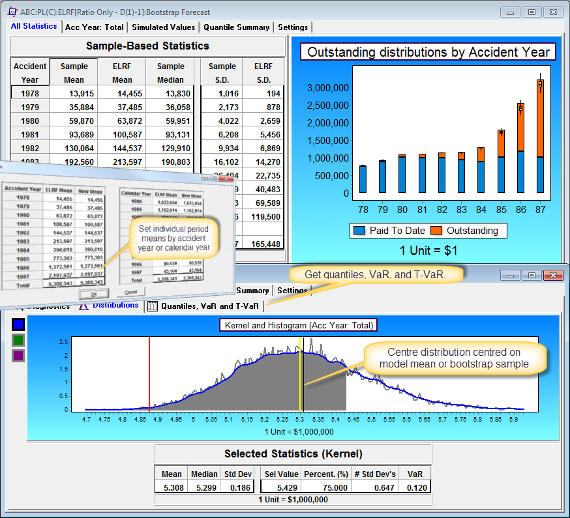
The bootstrap can be used to generate simulations from link ratio models
The bootstrap allows the generation of bootstrap sample distributions for the total, by accident year, and by calendar year.
The bootstrap functionality for ELRF is extended to provide output similar to PTF/MPTF Predictive Aggregate Loss Distributions (but based on bootstrap samples not parametric distributions). Value-at-Risk and Tail-Value-at-Risk are also calculated. The sample can be shifted to the ELRF model mean or any user defined means by accident year. This module provides another diagnostic to determine whether link ratio methods are appropriate for the data.
Model assumptions are explicit and can be tested
The ELRF regression framework provides the ability to determine statistically whether the selected link ratios quantify salient features of the data and whether they have any predictive power. Additional modeling components can be added and tested. These include intercepts and constant trends for each development period across the accident periods. Forecast standard errors are easily obtained for any fitted model in the framework.
Example: Company ABC
The following residual displays are obtained for company ABC for the volume weighted average link ratio method. This array is also discussed in the paper "Best Estimates for Reserves".
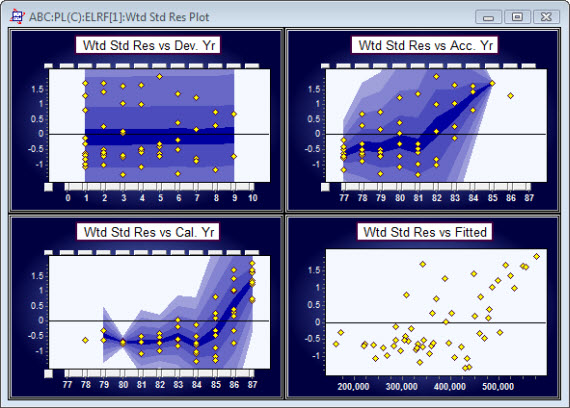
It is clear from the residuals versus calendar year display (bottom left) that there is a major calendar year trend change in 84-85.
It is impossible for link ratios to capture calendar year trend changes. This is one of the reasons the PTF modeling framework was created.
Further information on ELRF™ (along with instructions for ordering your own copy) is available here. A second example is available here.
See videos for a demonstration of ELRF™ functionality and use.