
Whenever a P&C insurance company implements a new reserving, pricing, or capital management platform, there can be concern from senior executives that the new tool may suggest a mean reserve millions of dollars away from the current held reserves already booked in the financial statements.
In the traditional modelling environment, actuaries are often required to adjust model structure, apply ad hoc modifications, or make other manual tweaks to achieve the desired result—undermining the integrity of the underlying modelling technique.
ICRFS™ forecast calibration does not operate this way.
When a prior best estimate is entered, the software automatically calculates the future calendar period trend adjustments required to reach that precise estimate. The statistical distribution characteristics otherwise remain unchanged.
This substantially reduces friction between existing methodologies and the ICRFS™ Probabilistic Trend Family (PTF) modelling framework.
The amended calendar period trends can then be assessed for reasonableness relative to historical experience. If an adjustment is required, it can be implemented in a strategically sound manner with strong supporting evidence. After all, reserve estimates from one valuation period to the next should not be more volatile than the paid loss data itself.
Our approach to resolving this concern is critical.
We do not change the core distributional assumptions, process variability, or volatility correlations. We simply adjust the future mean calendar trends. This preserves the mathematical tail risks (relative to the mean), volatility structures, risk capital calculations, and all other downstream probabilistic outputs.
An Anonymized Mini Case Study
We designed a model for the US Industry Private Passenger Auto (2025) after adjusting for earned premium as exposure. We found the historical calendar year trends are largely zero except for the period 2020 – 2022 – corresponding to COVID. To reach the reserves held, just completing the square, a future calendar year trend of around 10%+_ needed to be assumed vis a vis the recent historical experience of a zero trend.
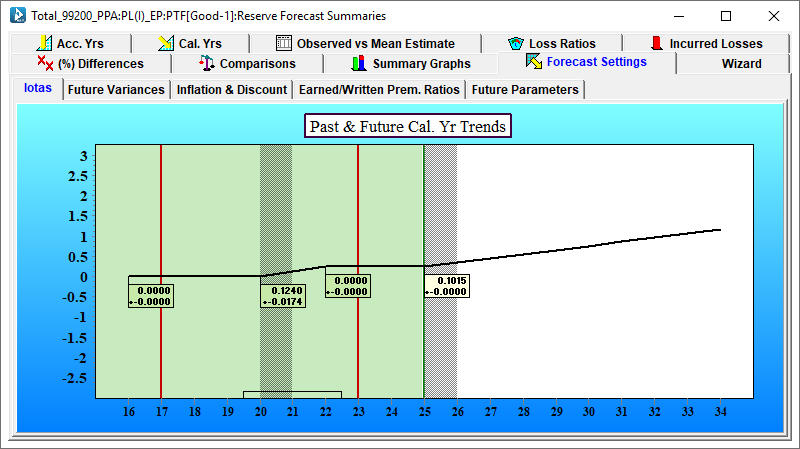
This visually demonstrates how easy it is to document the exact implicit assumptions behind executive decisions. If this was a live case study with a client, we would investigate the impact of extending beyond the last development period, the future liability stream, and look at amortization to adjust the best estimate over time as needed.
Other Benefits
Auditability & Regulatory Compliance
Under regulatory frameworks such as Sarbanes-Oxley, Solvency II, and IFRS 17, undocumented manual adjustments create significant governance and compliance challenges.
By using the built-in forecast calibration capability, every baseline modification is transparent, deterministic, and fully auditable. It cleanly separates objective historical measurement from subjective future corporate strategy, making reviews by auditors, regulators, and internal governance committees significantly easier.
What-If and Sensitivity Analysis
Senior executives do not want complex model rebuilds during a board presentation.
The ICRFS™ forecast calibration tool adjusts forecasts in seconds, allowing stakeholders to evaluate sensitivity analyses and "what-if" scenarios in real time during high-stakes corporate discussions. Rather than debating modelling mechanics, decision-makers can focus on understanding the business implications of alternative reserve strategies.